Jev Alternatives: When an LLM, GLiNER or Your Own Classifier Is the Better Tool
Jev turns text into typed decisions with probabilities. So do structured-output LLMs, zero-shot classifiers like GLiNER, and models you train yourself. What each one is better at, with the measured numbers where they exist.
 JevStation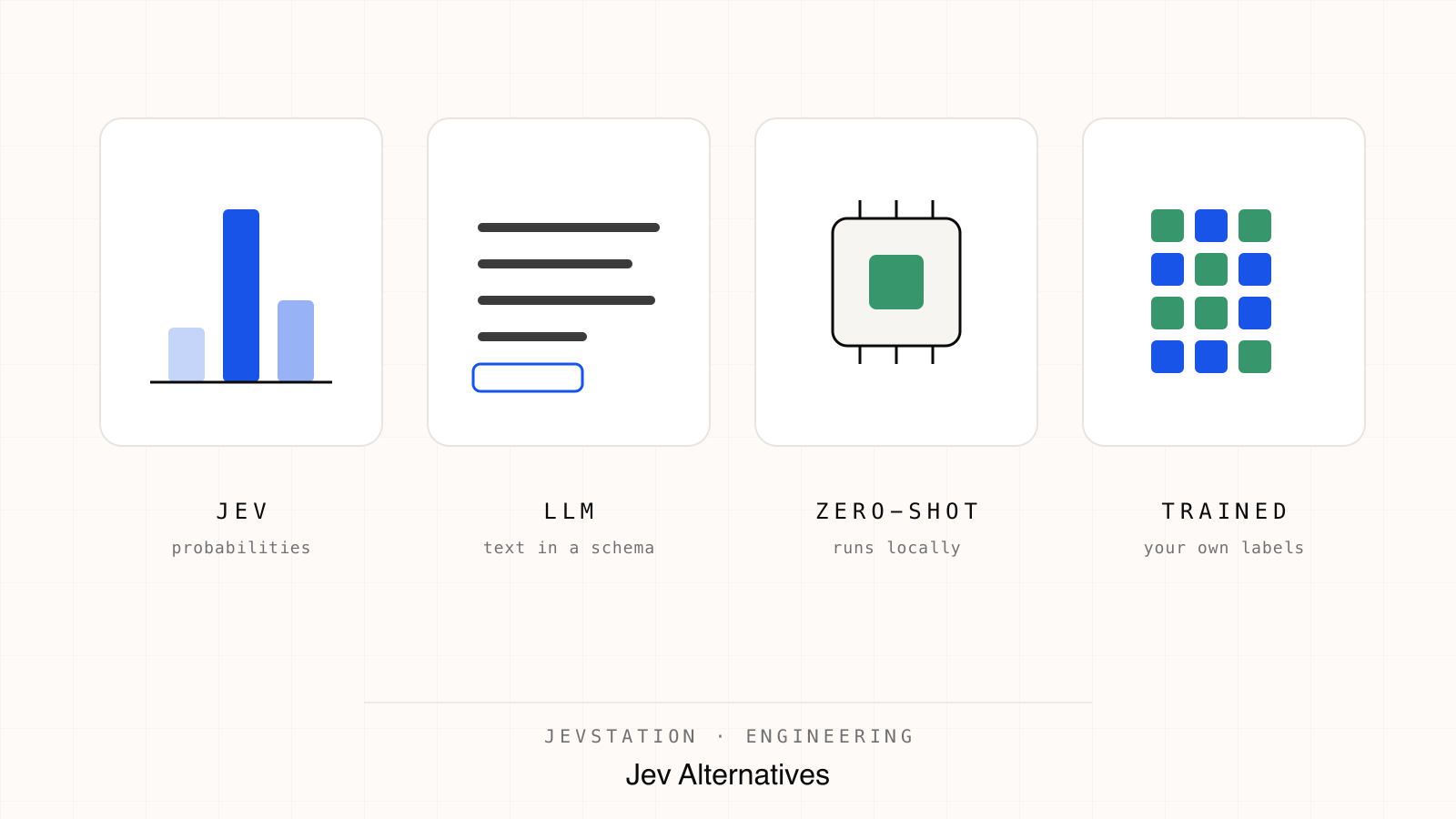
Jev is one of four ways to turn unstructured text into a decision your code can branch on. The other three are a general LLM constrained to structured output, a zero-shot classifier such as GLiNER, and a classifier you train on your own labels. None of them wins everywhere. This page is the honest version of that comparison, written by a site that runs Jev: where a measurement exists we cite it, and where one does not we say so.
| Option | Best when | What you give up |
|---|---|---|
| Jev | The answer space is known, decisions repeat, you act on confidence | Written reasoning; arithmetic; per-customer tuning |
| LLM with structured output | You need reasoning, text, maths, or an answer space you cannot list | Speed and cost per call; a probability you can threshold |
| Zero-shot classifier (GLiNER) | Few labels, and you want it local, offline, or on your own hardware | Accuracy on harder label sets, in the one head-to-head so far |
| Your own trained classifier | A stable label set, plenty of labelled data, very high volume | Setup and retraining every time the labels change |
Jev vs an LLM with structured output
A structured-output LLM still generates text; the schema constrains its shape. Jev does not generate text at all. In LangChain's words, Jev "isn't a drop-in replacement for an LLM. It doesn't generate text", but it can take over the classification jobs we currently hand to LLMs.
What that buys, by TypeSafe's own numbers (vendor-stated, not independently reproduced):
- Latency: 70–500 ms end to end, against the 3–329 s range TypeSafe cites for LLMs.
- Price: $0.042 per million input tokens with output free, against $0.20–$10 per million input tokens for the LLMs in their comparison, whose output TypeSafe puts at about 5x the input price. We measured what that means per call: $0.000012 to $0.000377 per evaluation.
- Workflow benchmarks: 193.6x faster and 444.6x cheaper, which TypeSafe describes as the higher end of real-world gains.
Read those with TypeSafe's own caveats attached. Their accuracy reference is the average of two frontier LLMs rather than ground truth, the workflows were built by their own team, and the LLM runs went through their wrapper. The direction is not in doubt; the exact multiples are theirs.
Choose the LLM when you need the reasoning written down, the answer involves counting, arithmetic or dates (TypeSafe's jaggedness notes are blunt that Jev is not a calculator), you cannot enumerate the possible answers, or your inputs are mostly not English: the docs say other languages are handled, but not as well.
Jev vs a zero-shot classifier like GLiNER
This is the only comparison with an independent, pre-registered measurement. jev-benchmarks ran jev-1.13.0 against fastino/gliner2.5-multi-v1 on 100 held-out examples from each of three datasets:
| Dataset | Labels | Jev accuracy | GLiNER accuracy | Jev coverage at ≤5% error | GLiNER coverage |
|---|---|---|---|---|---|
| AG News | 4 | 0.910 | 0.700 | 0.830 | 0.240 |
| Banking77 | 72 | 0.870 | 0.610 | 0.860 | 0.270 |
| DAIR Emotion | 6 | 0.480 | 0.440 | 0.000 | 0.020 |
Coverage is the share of inputs you can act on automatically while keeping the error rate at or below 5%, which is closer to how either model gets used than raw accuracy. On two datasets Jev is clearly ahead. On the third, neither model is usable, and Jev was the worse-calibrated of the two (Brier 0.846 against 0.668). The authors call the result deliberately mixed, and it is a 300-example pilot, not a leaderboard.
Latency cut the other way. GLiNER ran locally on an Apple M4 Max CPU; Jev was a hosted API called from France. GLiNER answered in about 44 ms at the median on the 4- and 6-label tasks against Jev's 236–256 ms, while Jev was faster on the 72-label task (246 ms against 296 ms).
Choose GLiNER when the label set is small, the data cannot leave your machines, or you need an answer without a network round trip. Choose Jev when there are many labels, or you want to act only on the answers it is sure of.
Jev vs training your own classifier
Jev is not fine-tuned per customer. The same weights serve every account, and domain behaviour comes from what you put in the request. That is the whole trade against a classifier you train yourself, and we have no benchmark to settle it, only the reasoning:
- Your own model wins when the label set is stable, you already have plenty of labelled examples, and volume is high enough that even a very cheap API call adds up. It also learns your data's quirks, which instructions in a request can only describe.
- Jev wins when you have few or no labels yet, when the labels change (editing a question's criteria takes a minute; retraining does not), or when the same pipeline needs a dozen different decisions.
A practical middle path: start with Jev, log its answers and the ones people correct, and once you have a large, stable labelled set, test whether a trained model beats it on your data.
Jev vs an LLM judge
Grading model outputs is its own case, with its own evidence: one independent AI-control pilot found a single Jev question matching the published range of a reasoning model's monitor at a fraction of the cost, and failing in specific ways. Jev as a Judge covers it in full.
How to decide
Jev is the right tool when three things hold together: you can list the possible answers in advance, you make the same decision many times, and you can act on a confidence score, automatically above one threshold and via a person below it. What a System One Model Is explains why those three conditions are the whole idea.
If any of them fails, one of the alternatives above is the better tool. If they all hold, measure rather than trust any table here, ours included: paste twenty real inputs into the playground, ask the question you would ask in production, and compare the answers to what you know is right. The first 200 evaluations are free.
Sources
- Jev vs GLiNER accuracy, coverage, calibration and latency. jev-benchmarks (independent, pre-registered 300-example pilot)
- Latency, price, workflow benchmark multiples, and their stated biases. TypeSafe launch post (vendor)
- "Not a drop-in replacement for an LLM". LangChain (third party)
- No per-customer fine-tuning, language support. TypeSafe model docs (vendor)
- Counting, arithmetic and date weaknesses. Jev 1.13 jaggedness (vendor)
- Per-call cost. What One Jev Evaluation Costs (our measurement)